Order 05
The Priority
Ladder
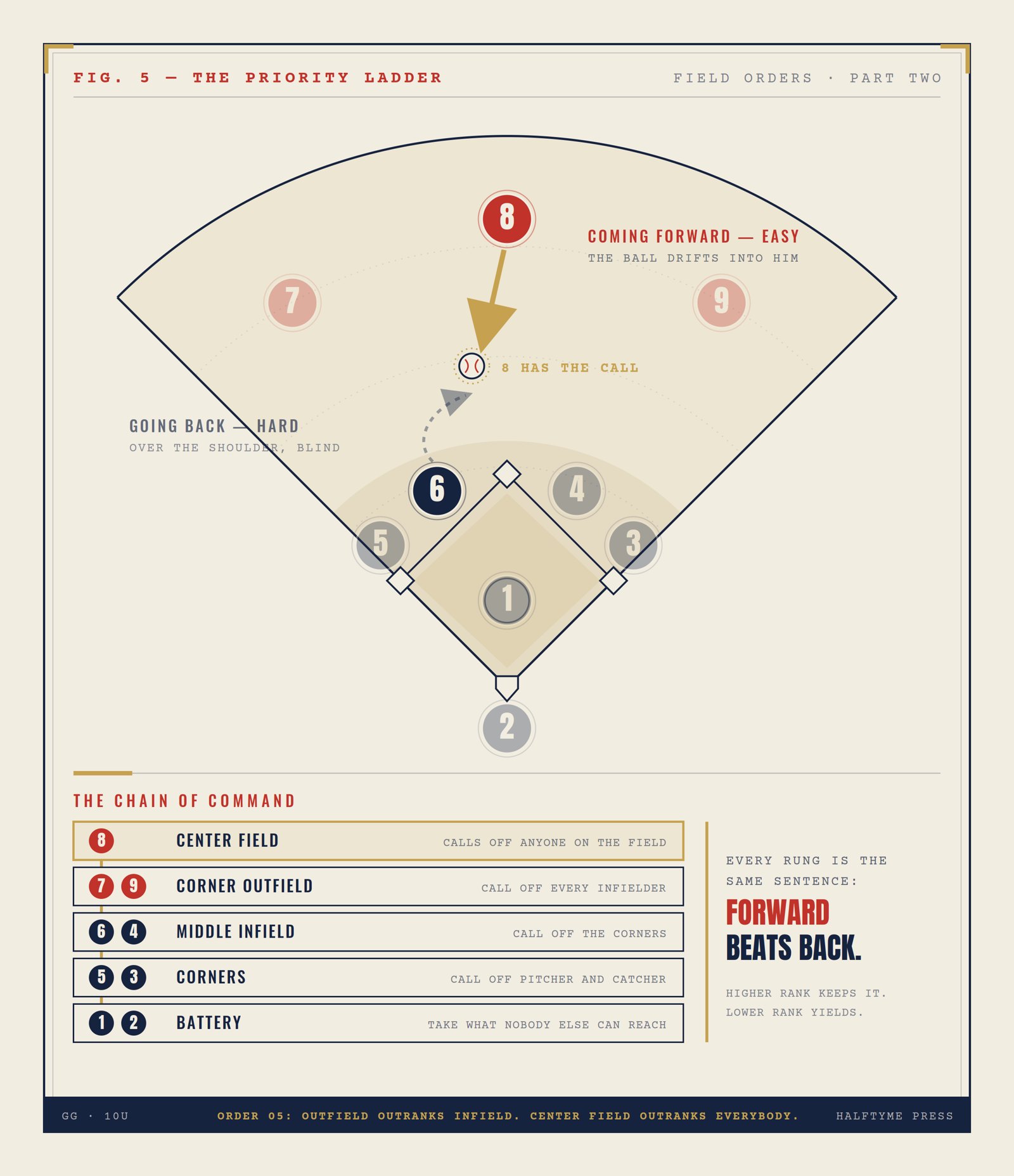
Two Generals under the same pop fly is not a hustle problem. It's a command problem — and it gets solved before the ball is ever hit.
Here's the whole reason the ladder exists. A ball in the air is drifting toward the outfielder and away from the infielder. Running forward under a ball you can see the whole way is easy. Running backward, over your shoulder, with your glove above your head, is hard.
So the man moving forward always outranks the man moving backward. That's it. Every rung on this ladder is that same sentence, said about two different players.
It's also why the outfielder should want it. He catches it moving toward the infield, already in position to throw — and if a runner is tagging, that throw is the whole play.
The Chain of Command
Four Reps — Write It In
Pop fly halfway between your shortstop and your left fielder. Both of them can get there.
High pop up over the mound. Pitcher, catcher, first and third are all circling under it.
Fly ball into the left-center gap. Left fielder and center fielder both have a real shot at it.
Now flip it. You're the shortstop drifting back on a shallow fly, and you hear nothing behind you. Whose ball is it?
The Trap
Most Generals get rep B wrong, and for a good reason — the pitcher is usually your best athlete, so it feels like his ball. It isn't. He's standing on a hill and the catcher is climbing out of a squat. First and third are already moving forward. Forward beats everything, even talent.
I've never once been mad about two guys running hard at the same ball. I've been plenty mad about two guys standing still, looking at each other, waiting to be told. Silence is the only real mistake here. Somebody has to open his mouth, and the ladder tells you who.
Outfield outranks infield.
Center field outranks everybody.
Order 06
Rules of
Engagement
The ladder tells you whose ball it is. The call is how everybody else finds out. A ladder nobody says out loud is worth nothing.
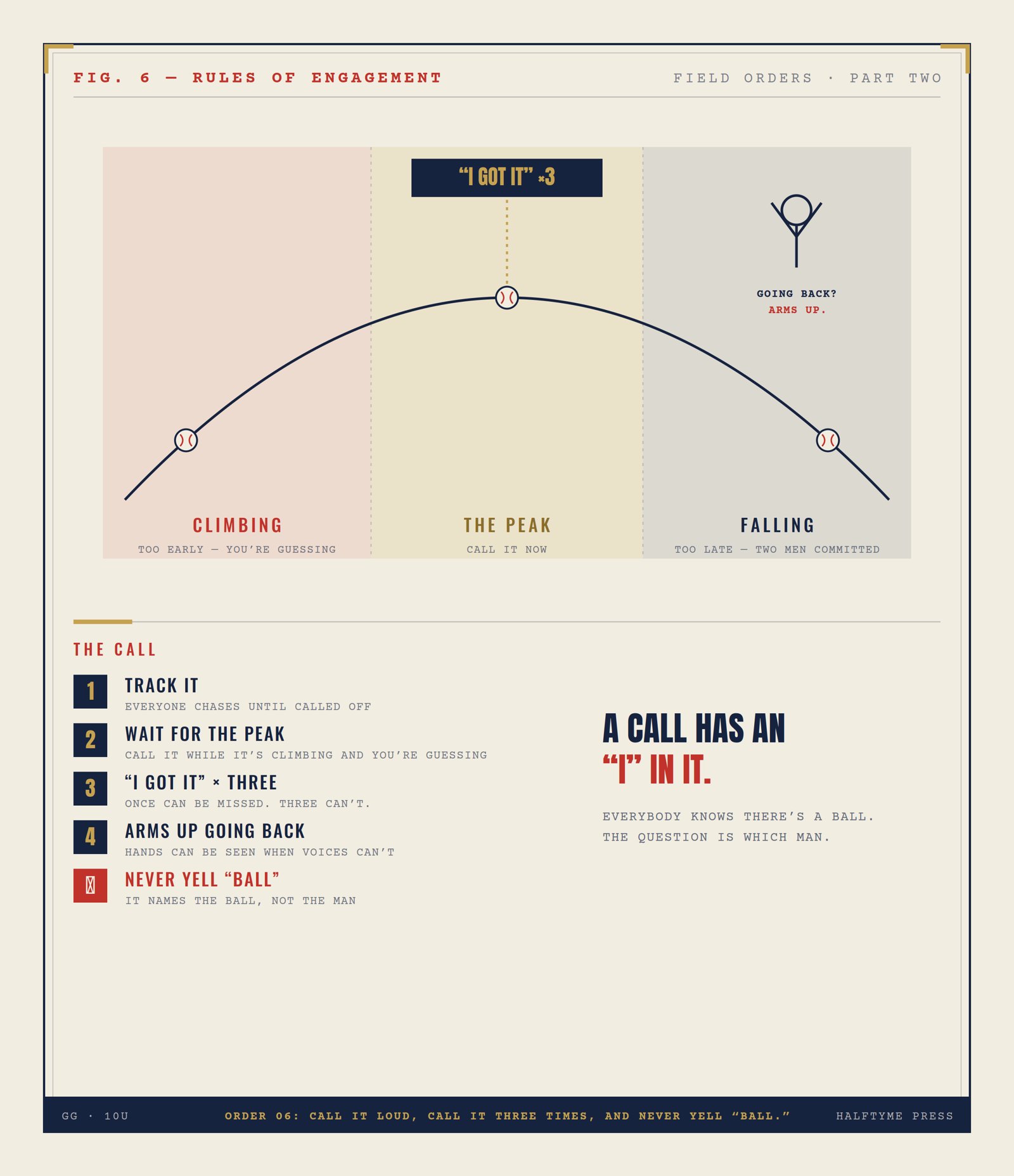
The call has rules, and they exist because a ball in the air is loud country — wind, parents, cleats, your own breathing. A call has to cut through all of it and leave zero doubt about who's catching.
Wait for the peak. Call it while the ball is still climbing and you're guessing. Young players call early because calling feels like hustle. It isn't — it's a promise you might not be able to keep, and a broken call is worse than none.
Three times, loud. "I got it, I got it, I got it." Once can be missed. Three can't. And if you're an infielder going back with your eyes on the sky, get your arms up — the outfielder charging at you can see hands he can't hear.
The Call
Four Reps — Write It In
Why do we wait for the peak instead of calling it off the bat? Say it in your own words.
You call a fly ball at the peak. Halfway down, the wind carries it and you know you can't get there. What do you yell?
Two players both yell "ball!" at the same time. What went wrong, and what should each have said instead?
You're at second base drifting back on a shallow pop, and you've called it. What do your arms do, and who is it for?
The Trap
"Ball, ball, ball" feels like a call. It isn't one. Everybody on the field already knows there's a ball — the question is which man is catching it, and "ball" doesn't answer it. "I got it" has an I in it. That's the whole point.
The bravest thing on this page is rep B. Calling a ball and then giving it up when you're beat isn't quitting — it's the most honest play in baseball. The kid who yells "you take it" when the wind wins just saved an out. Nobody claps for him. I do.
Call it loud, call it three times,
and never yell "ball."
Order 07
Yielding the
Right of Way
Getting called off is not the end of your play. It's the middle of it. The man who yields has two jobs left, and most players do zero of them.
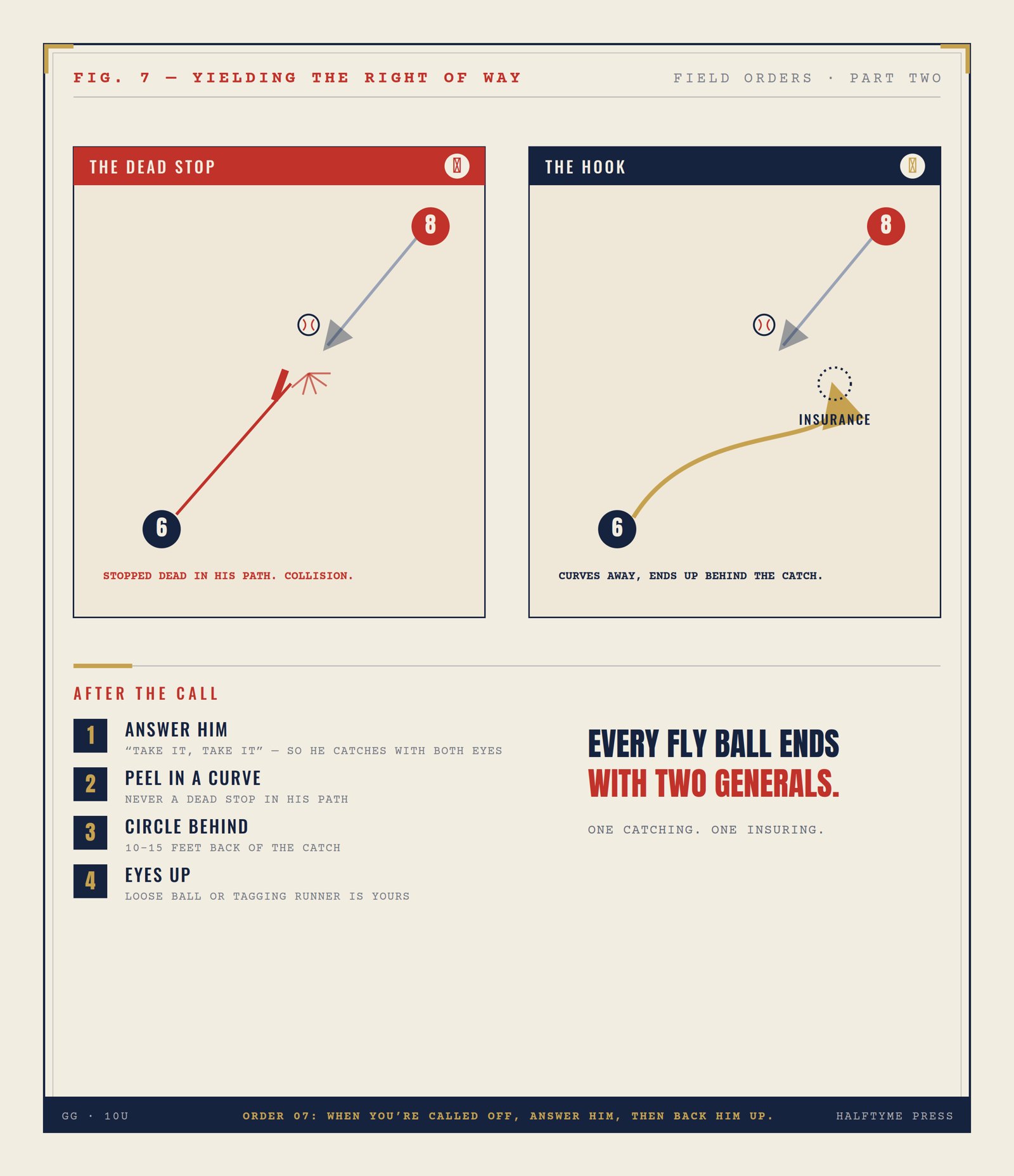
Job one: answer him. When you hear the call, say "take it, take it." That's the confirmation — it tells the man catching that you heard, you're out, and he's not about to get run over. Silence leaves him catching with one eye on you, and a fielder watching two things drops both.
Job two: get behind the play. Peel off in a curve, not a dead stop — a sudden stop right in his path is how collisions happen even after a good call. Curve away, then swing around behind him. If the ball pops loose or a runner tags, you're the closest man to the mistake.
The ladder gave the play a first man. Yielding gives it a second one. Every fly ball should end with two Generals near the ball — one catching, one insuring.
After the Call
Four Reps — Write It In
You're chasing a gap ball and your center fielder calls it. Write your next three moves, in order.
Why do we answer "take it" instead of just shutting up and getting out of the way?
Your left fielder calls it, catches it — and drops it on the transfer. Runner on second is halfway to third. Where should you already be, and what happens if you're there?
Why a curve instead of stopping dead in your tracks when you get called off?
The Trap
The called-off player who jogs back to his position with his head down thinks the play is over. Watch how many extra bases get taken in the three seconds after a catch. The play isn't over when the ball is caught — it's over when the ball is back in the infield and dead.
Yielding is a rank thing, and Generals should understand rank better than anybody. Standing down isn't losing the ball — it's taking the second post, and the second post saves more runs than the first one does. The best teammate on the field is usually the one who didn't make the catch.
When you're called off,
answer him, then back him up.
Order 08
Nobody's
Ball
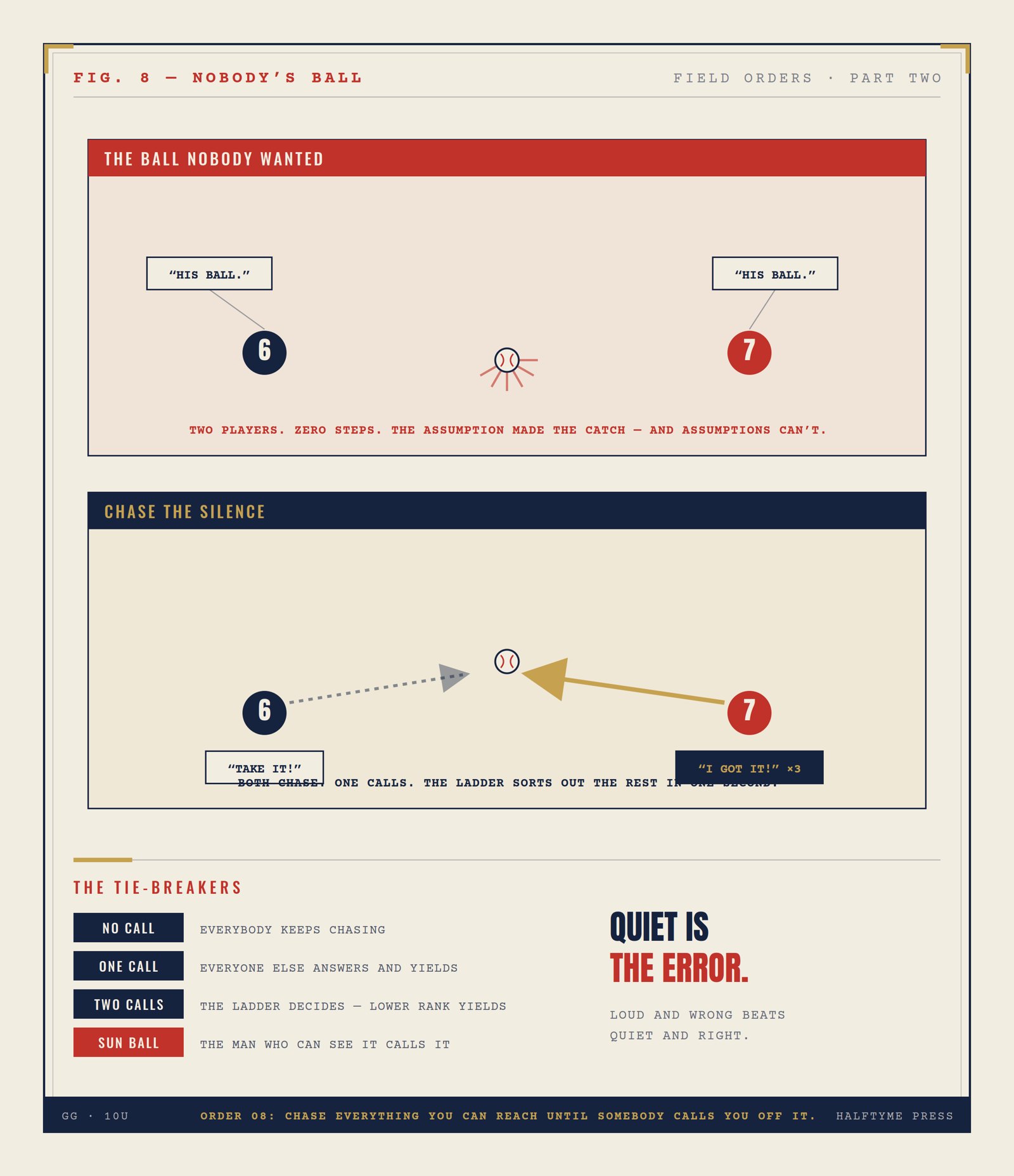
The ball that drops between two standing players didn't fall because nobody could reach it. It fell because each man decided it was the other man's ball.
So here's the rule that closes the gap in the ladder: you chase everything you can reach until somebody calls you off it. Not until you think he's got it. Not until it looks like his ball. Until you hear a voice.
"He's got it" is an assumption. Assumptions can't catch. If both players chase and one calls, the system worked. If both players chase and both call, the ladder breaks the tie — the higher rank keeps it, the lower rank yields. But if both players stand and watch, no rule on any page of this book can help you.
The tweener, the sun ball, the wind-blown pop — every one of them is testing the same thing: whether your team chases silence or waits in it.
The Tie-Breakers
Four Reps — Write It In
Blooper behind first base. You're at second, and it might be yours, might be the right fielder's, might be the first baseman's. When do you stop running after it?
You and the center fielder both call the same gap ball at the same time. Who keeps it, and what do you say next?
Pop fly into the sun. The ladder says it's the center fielder's ball, but he's lost it in the glare and you can see it fine from left. Whose ball is it now?
A ball drops untouched between short and left. Neither player moved more than two steps. Write what each one was probably thinking — and the one sentence that would have saved the out.
The Trap
The trap here is politeness. Nobody wants to be the kid who called a ball that wasn't his. But an over-called ball costs you nothing — the ladder sorts it out in one second. An un-called ball costs you a base hit every time. In this book, quiet is the error.
Here's the drill we'll run until you hate me: I toss tweeners all practice, and the only way to get it wrong is silence. Wrong man calling it? Fine. Both calling it? Fine — that's what rank is for. Nobody calling it is the only score against you. Loud and wrong beats quiet and right, every day of the season.
Chase everything you can reach
until somebody calls you off it.