Order 09
Move to
the Ball
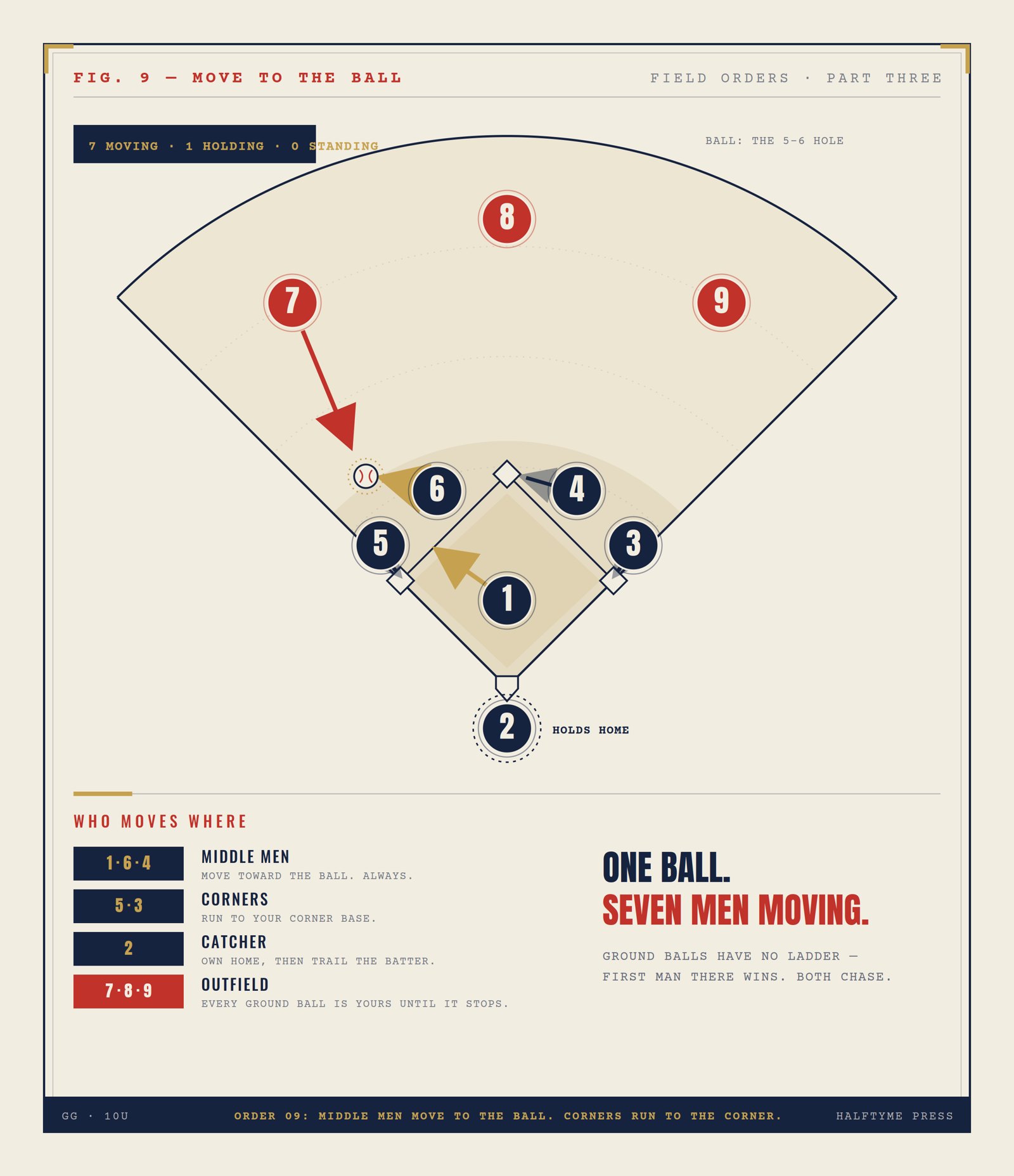
A ground ball puts nine men in motion, not one. If you're standing still when the ball is in play, you've made an error nobody scores.
The field splits into two kinds of jobs. The three men in the middle — pitcher, shortstop, second baseman — move toward the ball. Always. They're the rangers; the middle of the field belongs to them, and one of them is chasing every ball that gets through.
The corners work the other way. Third and first run to their base, because a corner man chasing a ball he can't reach leaves an empty bag behind him — and an empty bag is a free base for every runner on the field.
This one rule kills the two ugliest plays in youth baseball at the same time: the shortstop and second baseman both covering the bag while the ball rolls between them, and the first baseman chasing a ball into right field while the batter jogs to an uncovered first.
Who Moves Where
Four Reps — Write It In
Ground ball up the middle, just past the pitcher. You're the second baseman. The shortstop is also chasing it. Do you stop?
Slow roller to the first baseman, and he has to charge it. Who covers first, and where does he come from?
You're at third. Ball is hit sharply into the left-center gap — nowhere near you. Write your job anyway.
Why do the middle men chase while the corners retreat? It's the same reason, flipped. Say it.
The Trap
Rep A is where kids flinch. Two middle men chasing the same ground ball feels wrong — like the pop-fly collision all over again. It isn't. Ground balls don't have a priority ladder; they have a first-man-there rule, and the second man becomes the backup the instant the first man gloves it. Both chase. Neither stops.
Here's how I grade a ground ball from the dugout, and it has nothing to do with whether we got the out. I count the moving Generals. Seven or more and we're a real team, whatever the scoreboard did. Three or fewer and I don't care that the play worked — we got lucky, and luck runs out by the fourth inning.
Middle men move to the ball.
Corners run to the corner.
Order 10
Covering
the Bases
Order 09 put everybody in motion. This order tells you where the motion ends: four bags, and every one of them owned, on every play.
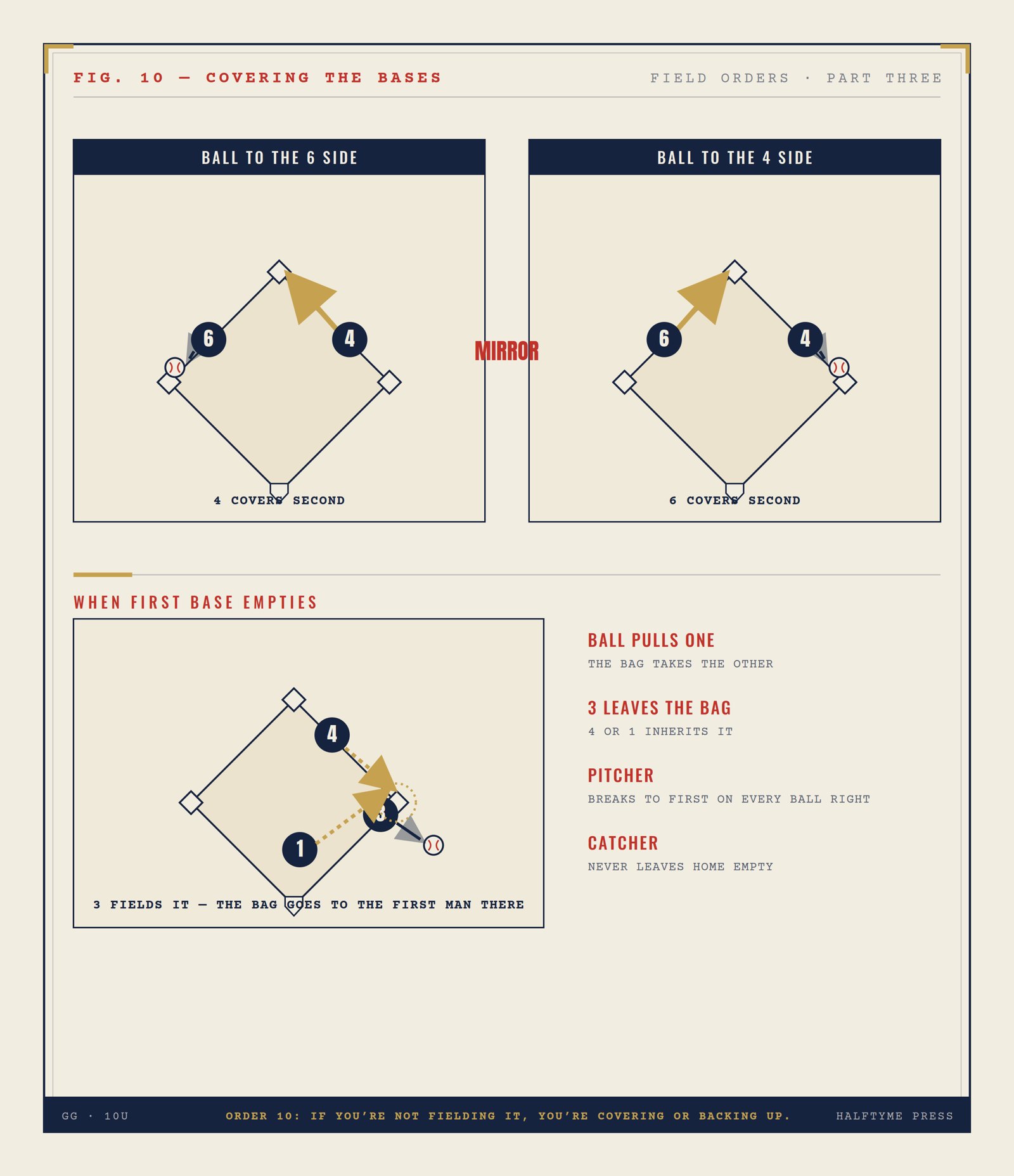
The rule that decides who covers second is the simplest one in the book: the ball pulls one middle man, the bag takes the other. Ball hit to the shortstop side, second baseman covers. Ball hit to the second-base side, shortstop covers. Same on a steal — whoever the batter is less likely to pull the ball toward takes the throw.
First base has its own version: when the first baseman leaves the bag to field, the second baseman inherits it — unless the pitcher gets there first, and the pitcher should be trying. Every ball to the right side, the pitcher breaks for first. Every time. Even when he doesn't need to. The one time he doesn't go is the one time he needed to.
And the catcher never leaves home empty while runners are on. His bag is the one they're all trying to reach.
Who Inherits the Bag
Four Reps — Write It In
Runner on first takes off stealing. Ground ball never comes — it's a pitch in the dirt. Who's covering second, and what decided it?
Ground ball wide to the first baseman's right. He ranges over and gloves it — now he's 15 feet from the bag. Walk the play home.
You're the pitcher. Ball hit to the right side — the first baseman has it easily and won't need you. Do you still break for first?
Ball hit deep in the hole at short. The shortstop is chasing it — so who has second, who has third, and who told them?
The Trap
Rep D's third blank is the real question. Nobody told them — that's the answer. Coverage isn't assigned during the play; it was assigned the moment the ball picked a direction. If you're waiting for somebody to yell your name, you're already late. The ball is the order.
Every base that stands uncovered for three seconds is an invitation, and good baserunners read invitations fast. Play a team that's been coached and watch what they do to an empty bag. Then decide you'll never be the empty bag. Covering is boring right up until it's the whole ballgame.
If you're not fielding it, you're covering
or backing up. Nobody stands still.
Order 11
Backing
Up
Every throw in a baseball game is a plan. Backing up is what your team does about the fact that plans miss.
Here's the math that makes this order worth a whole page. A missed throw with a man behind it costs you nothing — the runner holds, the ball comes back, the game goes on. A missed throw with nobody behind it costs a base, sometimes two, sometimes a run. Backing up is the cheapest insurance in baseball. It costs a sprint. That's the entire price.
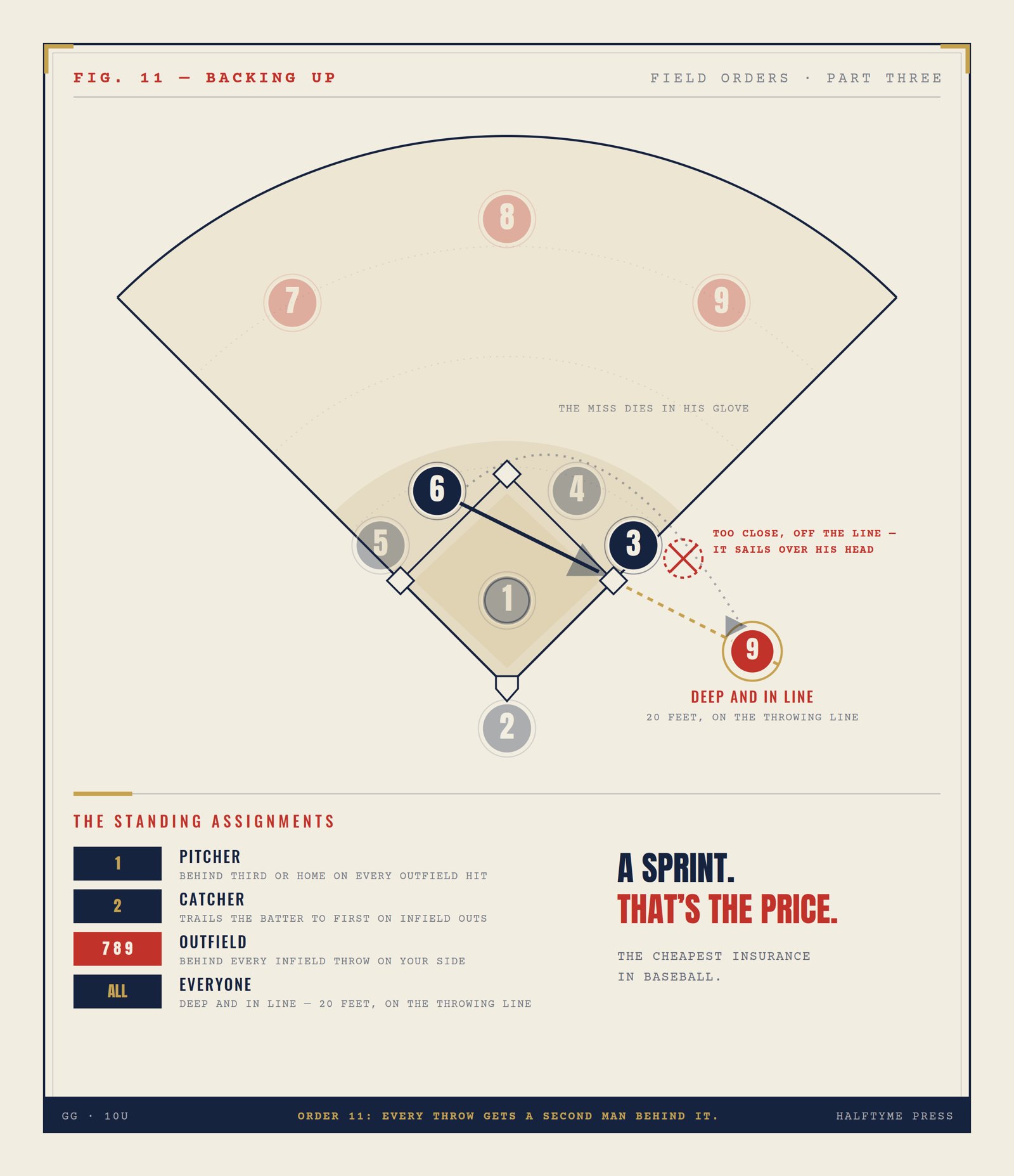
The rule for where to stand: get deep and in line. Twenty feet behind the bag if you have room, on the line the throw is traveling. Ten feet behind the play, an overthrow sails over your head too — you sprinted for nothing. Deep and in line, and the mistake dies in your glove.
The pitcher carries the heaviest load here. Ball to the outfield with runners on, and he's sprinting to back up third or home — whichever base the play is coming to. He threw the pitch. He insures the ending.
The Standing Assignments
Four Reps — Write It In
Ground ball to short, routine throw to first. You're the right fielder. Where exactly do you go?
Single to center, runner on second heading home. You're the pitcher. Where are you sprinting, and why there instead of the mound?
Batter grounds out to third, nobody on. Most of your team relaxes. Who's still working, and where?
The throw you backed up never gets away — the play works clean, and your sprint gets touched by nobody. Was it wasted?
The Trap
Backing up feels optional because it almost never gets used. That's the trap — you back up forty throws, and thirty-nine of them are fine, and you start to coast. Then the fortieth one skips into foul ground and rolls to the fence, and you're standing on the grass watching a run score that you'd already paid to prevent. Insurance only works if you buy it every time.
Backing up is the most honest stat in baseball because nobody keeps it. No scorebook column, no cheer from the bleachers, no highlight. Just a kid sprinting forty feet so that a mistake that hasn't happened yet won't matter. When I talk about playing like a General, this page is what I mean.
Every throw gets a
second man behind it.
Order 12
Where's
the Out
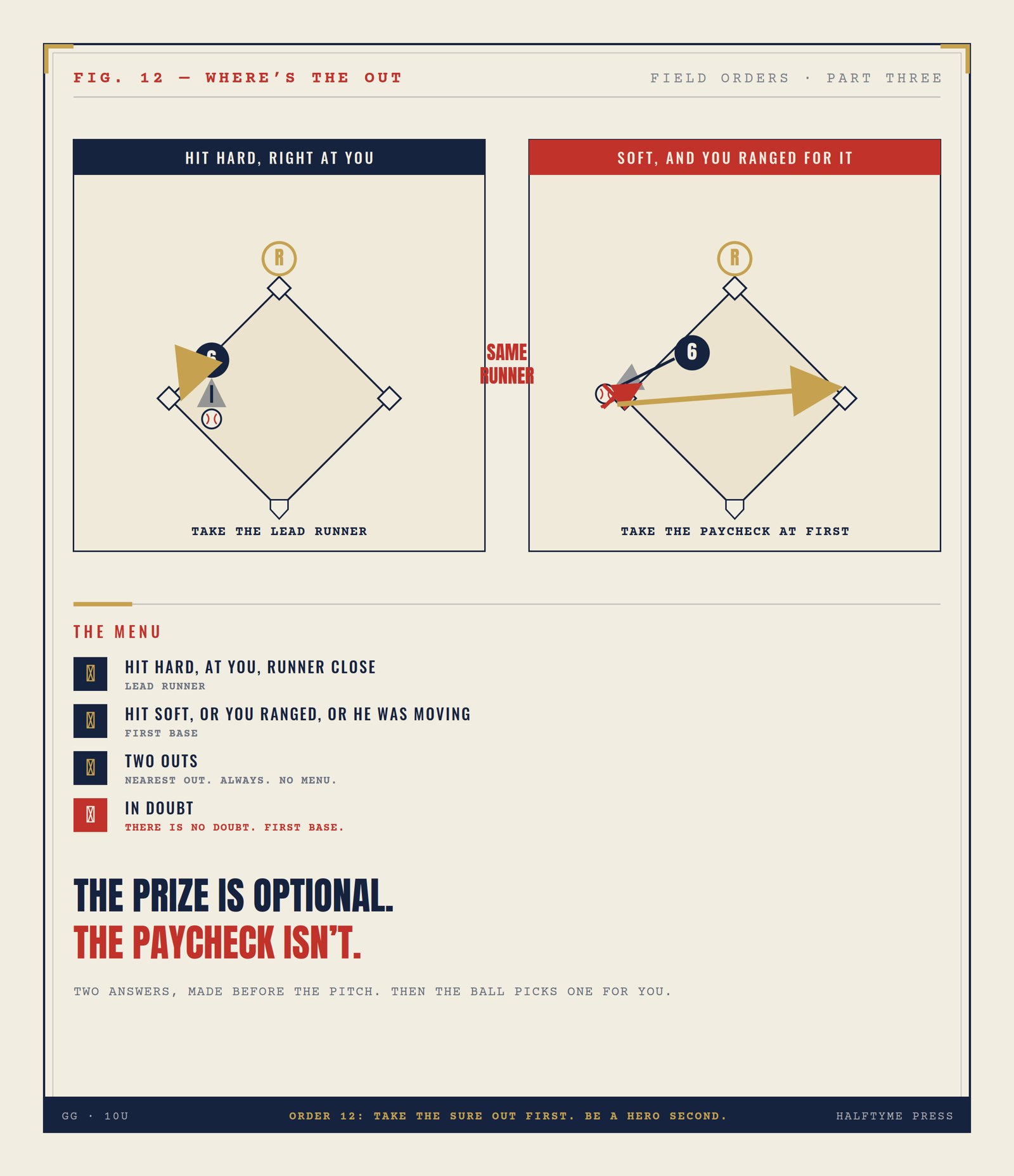
Every ground ball offers you a menu. The lead runner is the prize. The sure out is the paycheck. Knowing which one you're allowed to want is the difference between aggressive and reckless.
Getting the lead runner is always worth more — it kills the runner closest to scoring. But it's only on the menu when you can beat him there comfortably. Ball hit hard, right at you, runner barely off the bag: take him. Ball you had to range for, runner already moving on the pitch: he's gone. Forget him, take the paycheck at first.
The test is one question, asked before the pitch — because this is Order 02 and Order 03 doing their job. "If it's hit soft, where's my out? If it's hit hard, where's my out?" Two answers, made in advance. Then the ball picks one for you.
And the out count bends the whole menu. With two down, the lead runner stops mattering — any out ends the inning, so you take the closest one, every time. Greed is for early in the count of outs, never late.
The Menu
Four Reps — Write It In
Runner on first, nobody out, hard ground ball right at you at second base. Where's the out — and is there a second one behind it?
Same runner, nobody out — but this time it's a slow chopper and you're charging it. Where's the out now?
Runner on second, two outs, ball deep in the hole at short. The runner is breaking for third and it'll be close there. Where do you throw?
Write your two pre-pitch answers for this situation — runner on first, one out, you at third base: "hit hard at me I go ___, hit soft I go ___."
The Trap
The throw that airmails into left field trying to nail the lead runner wasn't a bad throw. It was a bad decision that turned into a throw. Almost every "error" on a lead-runner play was lost two seconds earlier, when a kid chose the prize over the paycheck on a ball that only paid the paycheck. Fix the choice and the arm fixes itself.
You will never get chewed out on my field for taking the sure out. Not once, not ever. The scoreboard doesn't know the difference between a boring out and a brave one — it just counts to three. Be the player who counts to three fastest, and let the other team be the heroes.
Take the sure out first.
Be a hero second.