Order 13
The Cutoff
Man
No ten-year-old can throw a ball from the fence to home plate. The cutoff man is how your team throws it anyway — two arms doing the work of one that doesn't exist yet.
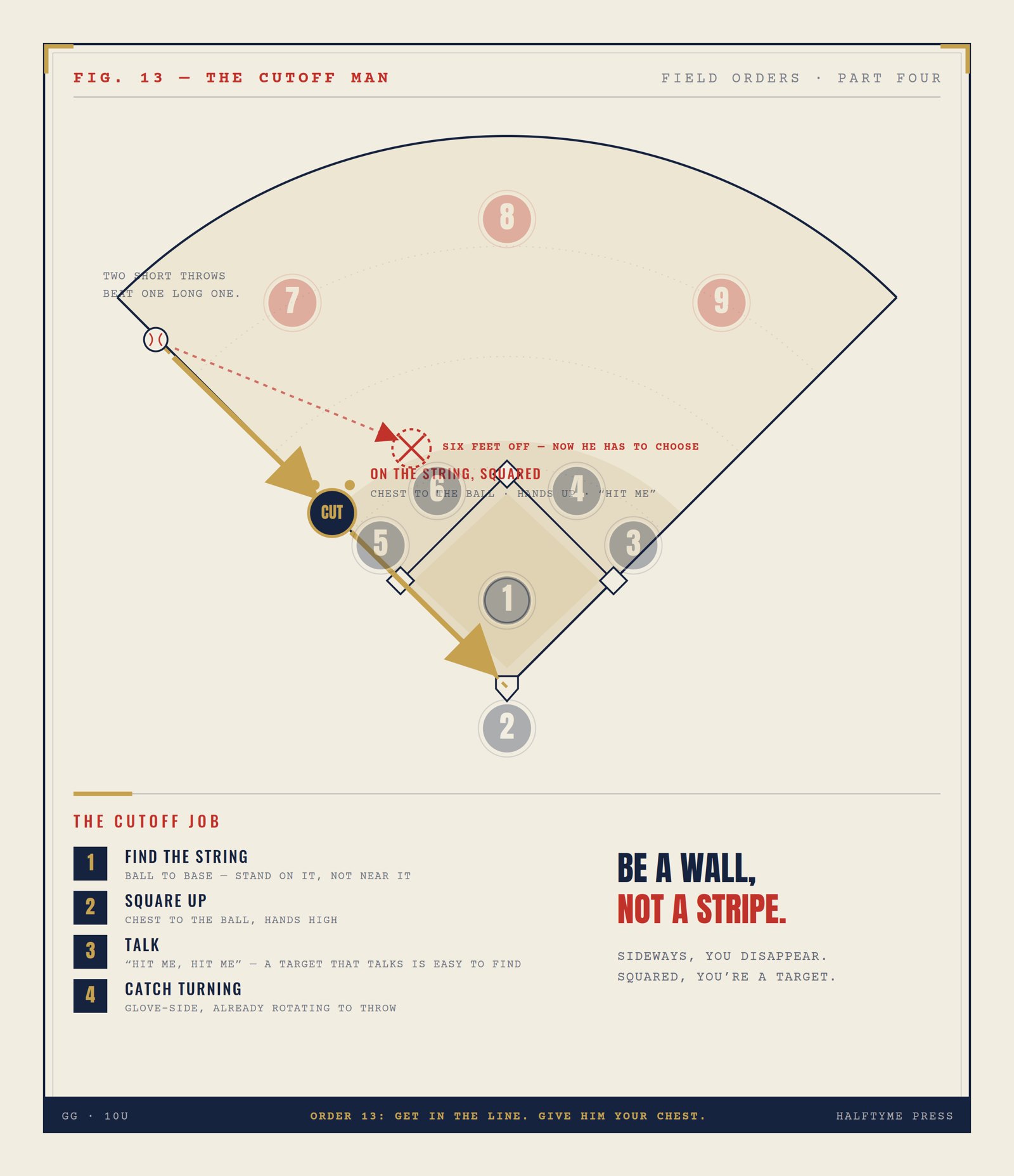
The job has two halves, and the first one is pure geometry: get on the line. Not near the line — on it. Draw a string from the outfielder's glove to the base the play is going to, and stand on the string. If you're six feet off the line, the outfielder has to choose between hitting you and hitting the base, and choosing takes time nobody has.
The second half is being a target worth hitting. Face the ball, square, hands up, and give him your chest. A cutoff man standing sideways is a stripe; a cutoff man squared up is a wall. Yell too — "Hit me! Hit me!" — because a target that talks is twice as easy to find as one that doesn't.
Where on the string? Close enough to the outfielder that his throw reaches you in the air, on a line. His job is a strong, flat throw to your chest. Yours is everything after.
The Cutoff Job
Four Reps — Write It In
Base hit to right field, runner rounding second and heading for third. Draw the string in words: from where, to where — and who stands on it?
You're the cutoff man and the throw is coming. Write the three things your body is doing before it arrives.
The outfielder sails it ten feet over your head, all the way to the base, and the runner is safe anyway. What did the high throw cost that a chest-high throw to you wouldn't have?
Why does the cutoff man catch glove-side, already turning? What's he buying with that half-turn?
The Trap
Young outfielders believe the long heroic airmail is the better throw, because it looks like the ones on TV. But a ball ten feet in the air can't be cut, can't be redirected, and can't stop the trail runner from taking second behind the play. The big throw shows off your arm. The flat throw to the chest shows off your head.
Supply lines win wars, and relays win baseball games — same idea. The ball is supplies, and it has to move through stations to get where it's needed. One kid trying to carry it the whole way by himself isn't brave, he's a broken supply line. Two short throws beat one long one almost every time at this level. Trust the station.
Get in the line.
Give him your chest.
Order 14
Cut or
Let It Go
The cutoff man has the hardest no-decision in baseball: he never chooses. The voice behind the play chooses for him.
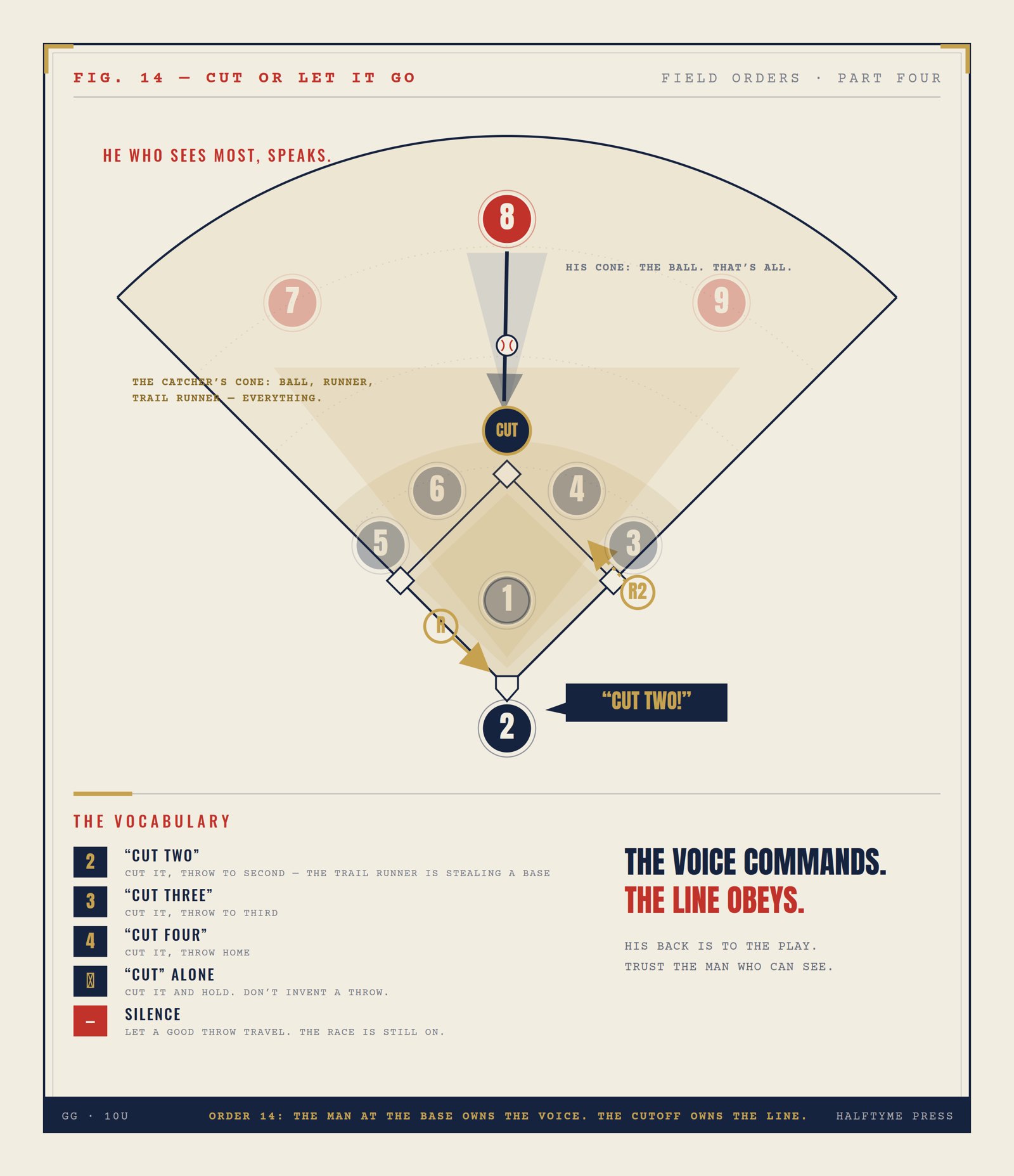
Here's why. The cutoff man is facing the ball, which means his back is to the play. He can't see the runner slowing down, can't see the trail runner getting greedy, can't see any of it. The man standing at the base can see everything. So the rule is absolute: the man at the base owns the voice. The cutoff owns the line.
The vocabulary is three calls and a silence. "Cut two!" — cut it and throw to second, the trail runner's stealing a base behind the play. "Cut three!" or "Cut four!" — same idea, third base or home. "Cut!" alone — cut it and hold, nobody's going anywhere, don't invent a throw. And silence means let it go through — the play at the base is live and the throw is on target. Silence is a call too. It's the one that means the race is still on.
The Vocabulary
Four Reps — Write It In
Throw coming home, runner clearly beat by fifteen feet — he's slowing down, giving up. Batter is sprinting for second behind the play. You're the catcher. What's your call?
Same throw home, but this one's a true race — bang-bang, on line. What's your call now?
You're the cutoff man. You hear nothing, but the throw looks way off line to you. Do you cut it on your own?
Why does the cutoff man never make this decision himself, even when he's your smartest player? One sentence about what he can't see.
The Trap
Rep C is the honest one. The textbook says silence means let it go — but a throw dying in the grass twenty feet up the line helps nobody at any base. So here's the full rule, the one the textbook mumbles: silence means let a GOOD throw go. A throw that's clearly never getting there, you cut and hold. The voice commands the play. Physics outranks the voice.
This is the first order in the book where a General takes a command instead of giving one, and I want you to notice how that feels. The cutoff man is the most skilled player on the play and he's also the one who obeys. That's not a demotion. Armies work because the man who can't see the field trusts the man who can. So do teams.
The man at the base owns the voice.
The cutoff owns the line.
Order 15
The Double
Relay
A ball in the gap or at the wall is too far for one relay throw. So we send two men — and the second one is not a spare. He has his own job.
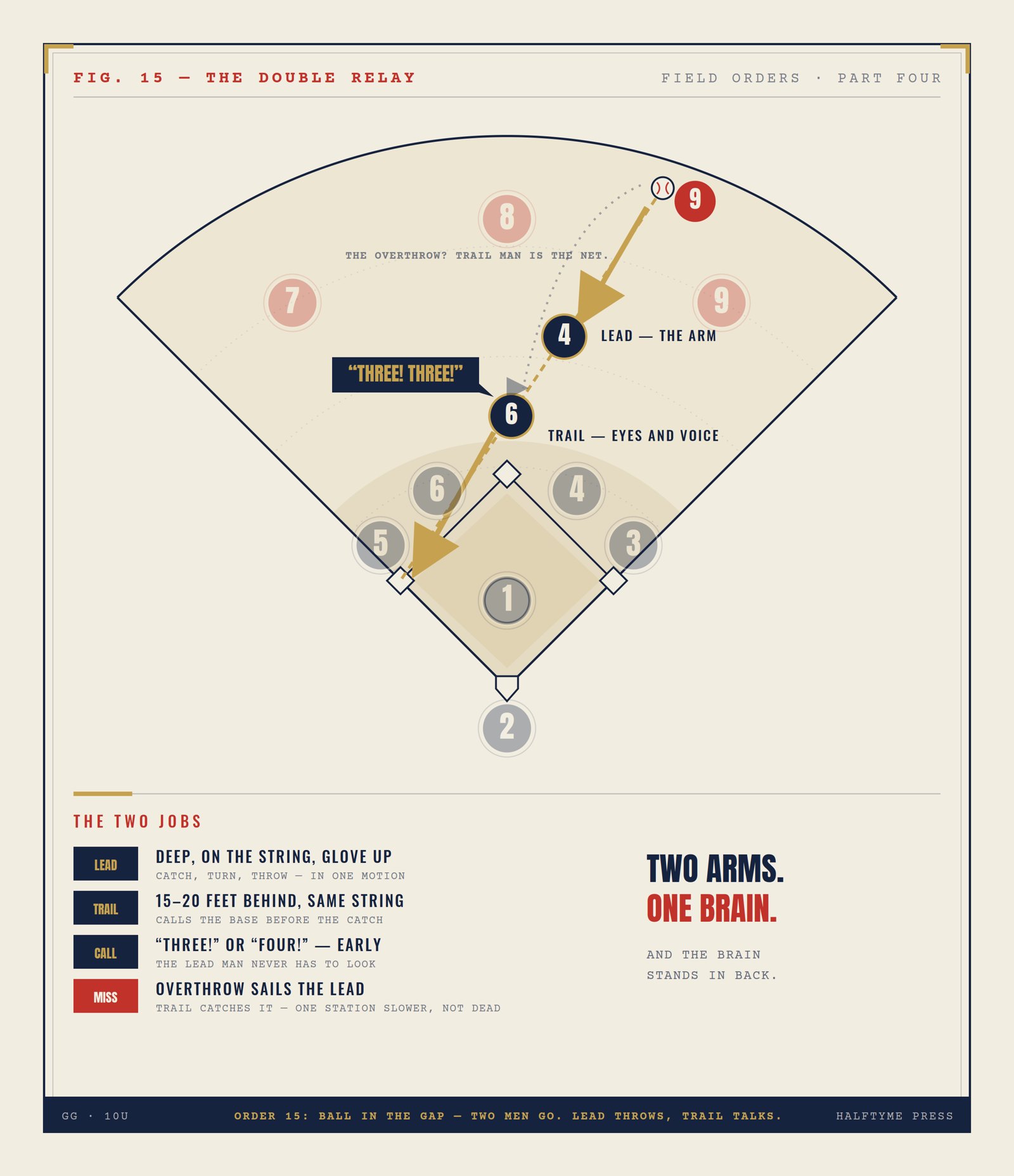
Ball past the outfielders, and both middle infielders sprint out together. The lead man goes deep, lined up with the base the play's going to — he's the arm. The trail man stops fifteen to twenty feet behind him, on the same string — and he's the eyes and the voice.
Why stagger them? Two reasons, and they're both about mistakes. If the outfielder's throw sails over the lead man, the trail man catches it and the relay is only one station slower instead of dead. And because the lead man is sprinting out with his back to the entire infield, the trail man tells him what to do before he even touches the ball: "Three! Three!" or "Four! Four!" — so the lead man catches, turns, and throws in one motion to a base he never had to look for.
Lead throws. Trail talks. Two arms, one brain, and the brain stands in back.
The Two Jobs
Four Reps — Write It In
Ball rolls to the wall in left-center. Which two players sprint out, and which one leads?
You're the trail man. The batter is rounding second hard as the outfielder reaches the ball. What are you yelling, and when do you start?
The outfielder's throw sails over the lead man. Walk the ball home from there — who has it, and what's still possible?
While both middle infielders are out on the relay, who's covering second base? Somebody has to be. Figure it out.
The Trap
Rep D is the one that unravels teams. Both middle men leave, and second base becomes nobody's — unless the first baseman slides over to take it, which pulls attention off the middle, which is exactly why the pitcher is sprinting to back up home. A wall ball moves all nine players. If you can name all nine jobs on that play, you can skip to Part Six.
The double relay looks like choreography when it works, and parents will ask how long you drilled it. Here's the secret: the drill isn't the running, it's the talking. The lead man's job is easy the moment the trail man's mouth is working. Every beautiful relay you've ever seen was really just one kid yelling a number early enough.
Ball in the gap — two men go.
Lead throws, trail talks.
Order 16
Runner
on First
One runner on first changes the whole map. Every single to the outfield is now a play at third — and one General owns that string every time.
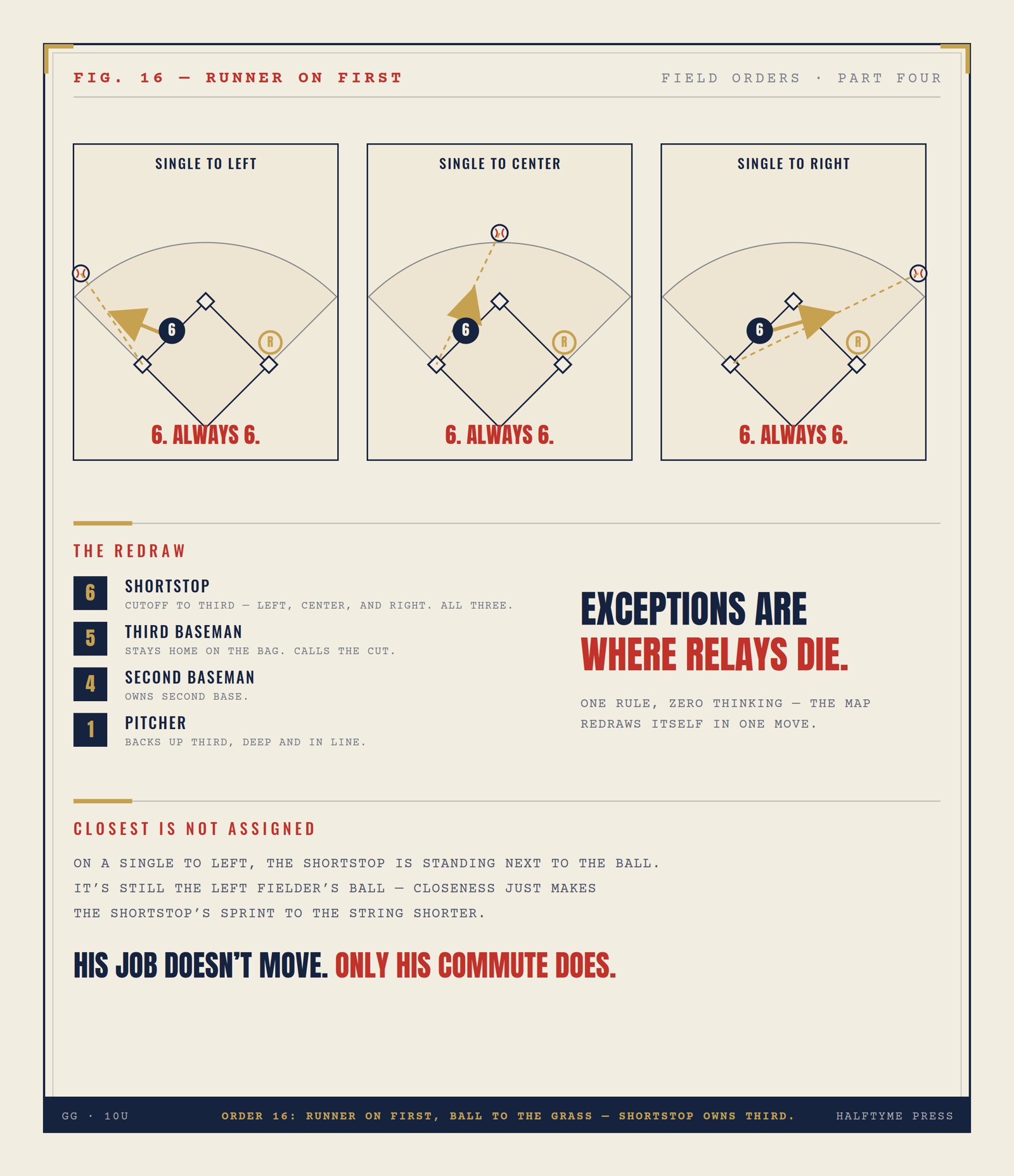
Base hit to the outfield with a runner on first, and the question is always the same: does he try for third? Your team's answer has to be ready before the ball lands. The cutoff to third is the shortstop — on a single to left, to center, and to right. All three. No exceptions, no sharing, no "whoever's closer."
Why one man for all three? Because exceptions are where relays die. The moment the assignment depends on where the ball went, somebody hesitates — and a hesitating cutoff man is worse than none, because the outfielder is counting on him. One rule, zero thinking: ball hits outfield grass with a runner on first, the shortstop is already moving to the string between the ball and third.
And the domino behind it: with the shortstop gone, the third baseman stays home on his bag and the second baseman owns second. The map redraws itself in one move.
The Redraw
Four Reps — Write It In
Runner on first, single to right field. Name the cutoff man to third, who's on the bag at third, and who's behind the bag.
Same situation, single to left. The shortstop is closest to the ball — does that change his job?
The runner rounds second, looks at your relay already set up — cutoff on the string, third baseman waiting — and retreats to second. No throw was made. Did the relay do anything?
With the shortstop out on the string and the second baseman on second — who's watching the batter, and what's the batter thinking about?
The Trap
Rep B is the whole order. On a single to left, the shortstop is standing practically next to the ball, and every instinct says "I'm closest, I'll field it." No. The left fielder fields it — that's his ball the moment it touches grass — and the shortstop's closeness just means his sprint to the string is shorter. Closest to the ball and assigned to the ball are two different things, and mixing them up collapses the relay.
Rep C is my favorite question in this whole part. A relay that never throws still wins — the runner saw the machine assembled and decided against testing it. Most of what a good defense does never shows up in the scorebook. It shows up in the bases the other team stopped trying to take.
Runner on first, ball to the grass —
shortstop owns third.