Order 17
Bunt
Coverage
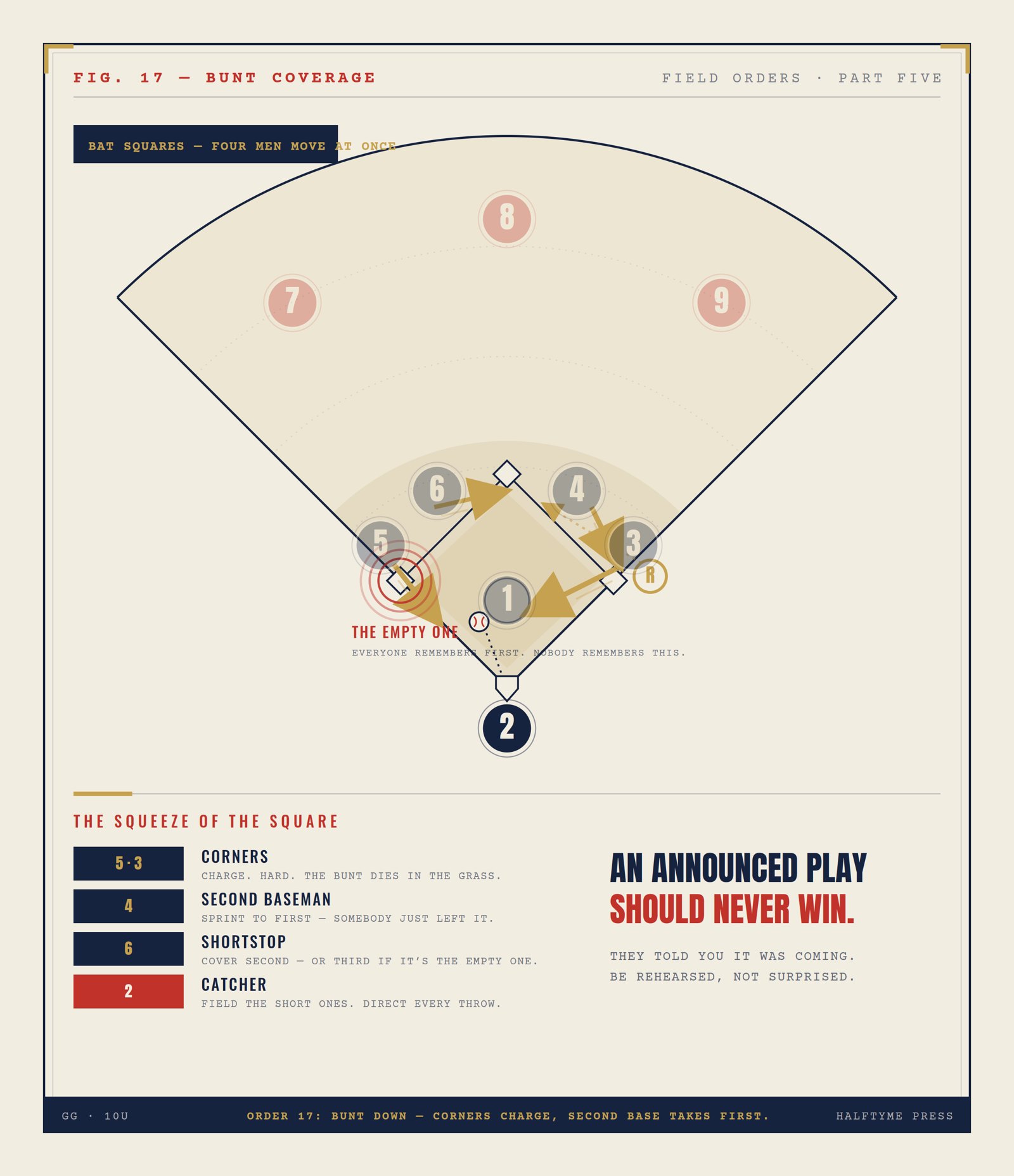
A bunt isn't a surprise. It's an announcement — the batter squares, and for one second the whole field knows what's coming. The team that rehearsed its answer wins the second.
The moment the bat turns flat, four men move at once. The corners charge — third and first sprint in hard, because a bunt dies in the grass and somebody has to get to it before it stops. The second baseman sprints to first, because the first baseman just left it, and a bunt with no one at first isn't a sacrifice anymore, it's a single. The shortstop takes second — or third, if the runner's coming from second and third base is the one standing empty.
That last piece is the one that loses games. Everybody remembers the charge. Everybody remembers first base. The empty bag behind the play — the one the corners just abandoned — is the one the smart team is actually bunting at.
Fielding the bunt itself is one rule: whoever gets there first calls it, and the catcher directs the throw — he's the only one facing the whole field.
The Squeeze of the Square
Four Reps — Write It In
Runner on first, batter squares to bunt. Write where all four infielders go — before the ball is even touched.
Same play — why does the second baseman cover first instead of the pitcher, who's closer?
Runner on second now, batter squares. Which base is the dangerous empty one, and who has it?
The bunt is fielded cleanly by the third baseman. Who tells him where to throw, and why him?
The Trap
The charging third baseman who fields the bunt and then spins to find third base uncovered — because he's the one who was supposed to be standing on it — just learned why the shortstop's rotation matters. The bunt doesn't beat you at first base. It beats you at the bag everyone forgot was part of the play.
We will rehearse this rotation until you can run it with your eyes closed, and here's why: a bunt is the only play in baseball where the other team tells you what they're doing before they do it. If an announced play still beats us, that's not their execution — that's our preparation. Announced plays should never win.
Bunt down — corners charge,
second base takes first.
Order 18
First and
Third
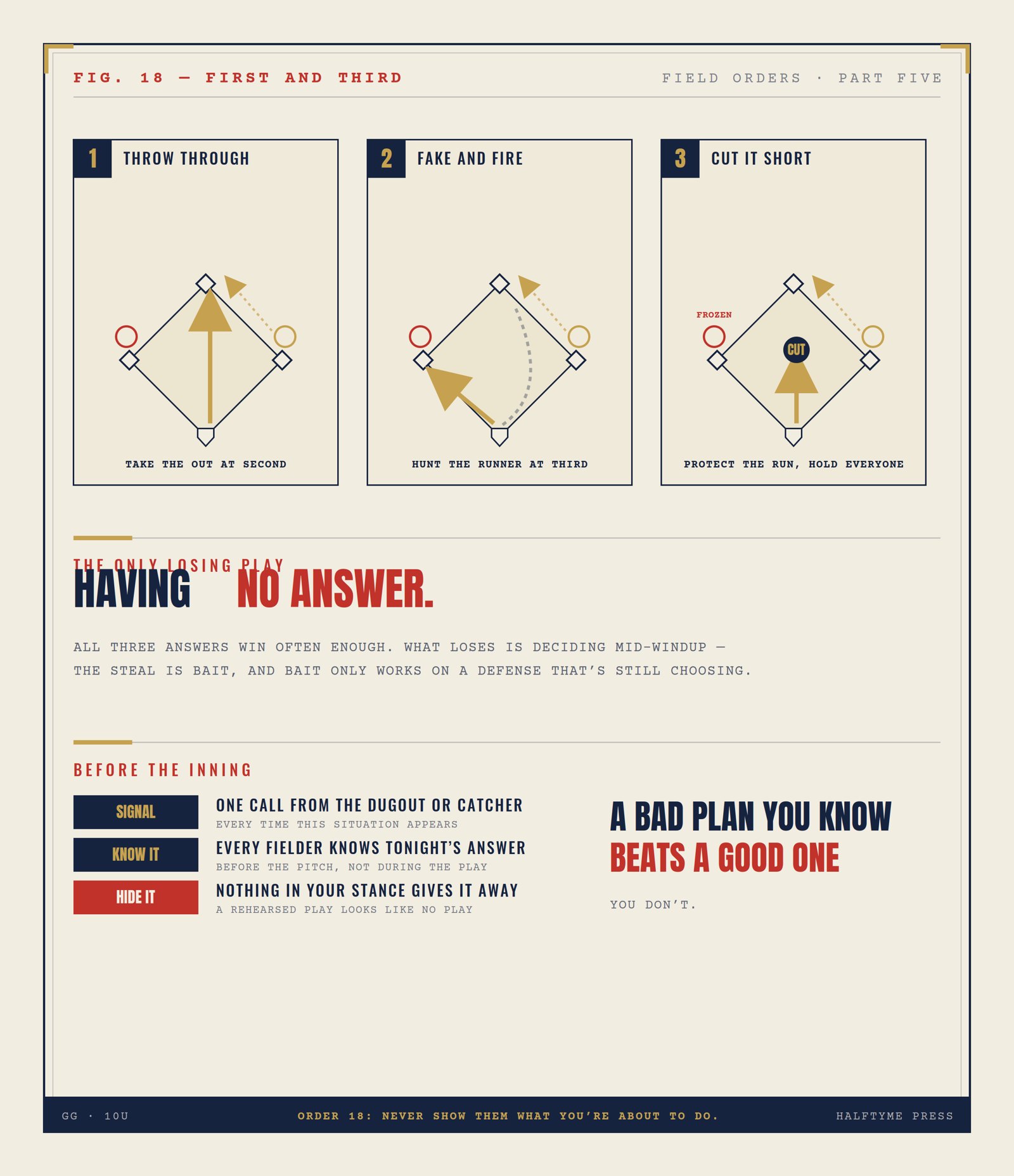
Runners on first and third is a trap dressed up as a steal. The runner on first takes off, and he's bait — the run is standing on third, waiting for your catcher to take it.
Every defense needs an answer chosen before the inning, because the one thing you cannot do is decide during the play. There are three standard answers, and they're all fine — what's fatal is having none.
Throw through: the catcher fires to second like the runner on third doesn't exist. Best when the runner on third is slow or the game situation can afford the run. Fake and fire: the catcher pump-fakes toward second, then snaps to third to catch the runner leaning. Best against aggressive teams. Cut it short: the throw goes toward second but the pitcher — or a crashing middle infielder — cuts it in front of the bag and looks the runner back. The safest, and the standard call when the run matters.
The signal comes from the dugout or the catcher, every time this situation appears. Your only job as a fielder: know tonight's answer before the pitch.
The Three Answers
Four Reps — Write It In
Why does the runner on first steal in this situation when he'd never steal it straight up? What is he really doing?
Tie game, last inning, runner on third is their fastest player. Which of the three answers do you want, and what are you giving up to get it?
You're up eight runs. Same steal. Now which answer — and why did the score change it?
You're the shortstop and you never got the signal. The runner takes off. What's the one thing you must NOT do, and what's your safe default?
The Trap
The catcher who makes up his mind mid-windup is the one who throws it into center field. This play punishes improvisation harder than any other in the book, because the bait only works on a defense that's deciding in real time. A rehearsed answer executed slowly beats a brilliant answer invented at full speed.
Notice what the order says: never show them what you're about to do. It doesn't say which answer to pick — because the answer changes with the night, the score, and the runner. What never changes is that we decided together, before the pitch, and eight other Generals aren't guessing. A team with a bad plan it knows beats a team with a good plan it doesn't.
Never show them what
you're about to do.
Order 19
Runner
on Third
A runner ninety feet from home changes what every ground ball means. Now the infield has a choice to make before the pitch — and a weapon most kids never use.
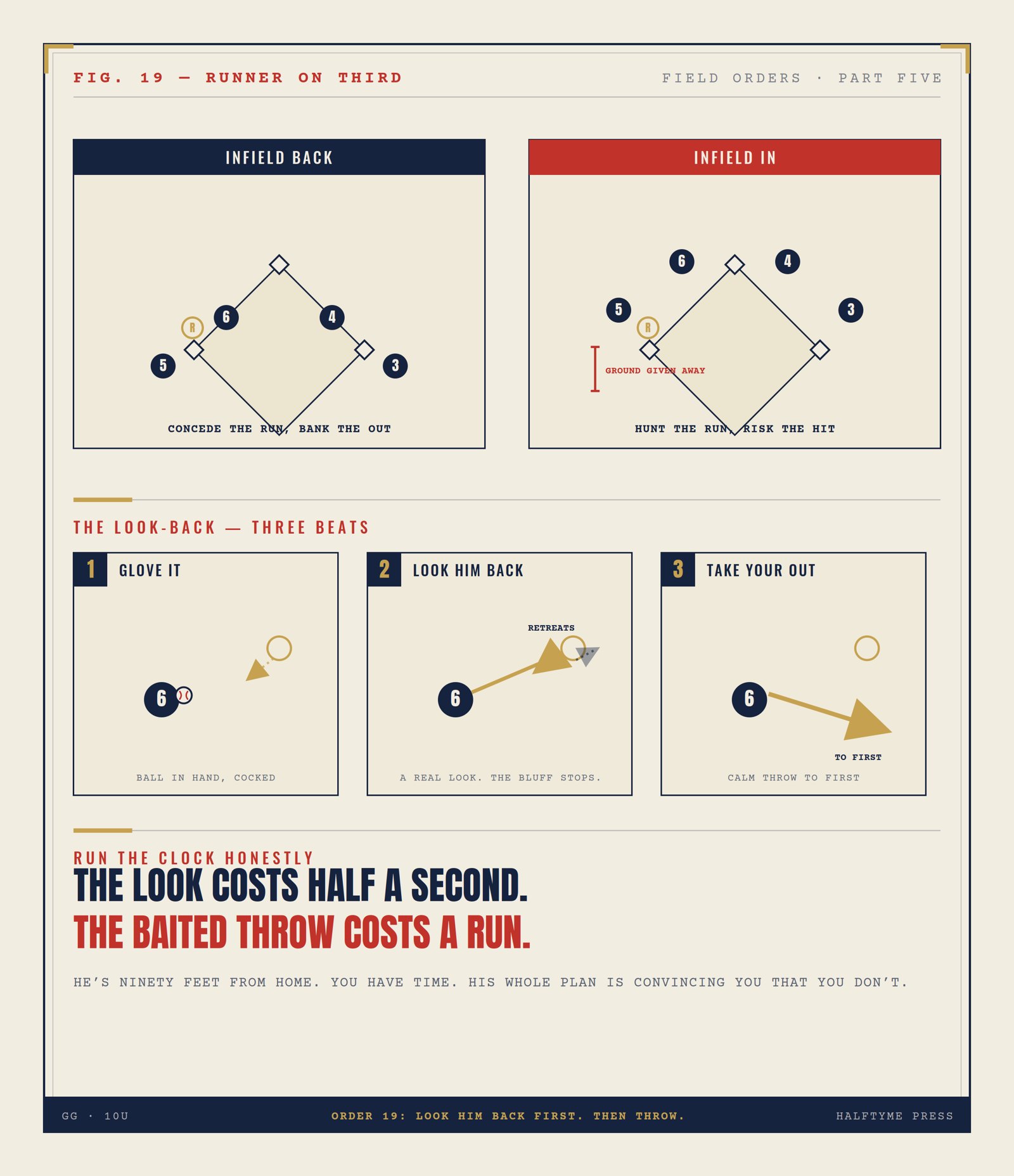
The choice is depth. Infield back is normal depth: you're conceding the run on a ground ball to take the sure out at first. Infield in — everyone up on the grass — is the trade going the other way: you're closer, so you can throw the runner out at home, but every ground ball gets to you faster and hits get through easier. In means the run matters more than the out. Back means the out matters more than the run. The coach calls it; your job is to know what it means for your throw.
The weapon is the look-back. Ground ball to you with the infield back, and the runner on third is dancing, bluffing a break for home. Don't throw at the dance. Look at him — a real look, ball cocked. If he's bluffing, he stops. Then take your out at first. The look costs half a second. The throw home that he baited out of you costs a run and the out.
The Depth Trade
Four Reps — Write It In
One out, tie game, last inning, runner on third. In or back — and what did the score just buy?
Up six runs, second inning, runner on third. In or back now — and why is this the opposite answer?
Infield back, ground ball to you at short, runner on third bluffing hard toward home. Walk your next three beats.
Same ball — but this time he's not bluffing, he broke for home on contact. What changes, and what's your target?
The Trap
The bluff works because the dancing runner makes the play feel urgent, and urgent hands throw early. But run the clock honestly: he's ninety feet from home, and your look takes half a second. You have time. You almost always have time. The runner's entire plan is convincing you that you don't.
The look-back is my favorite play to teach because it's pure poise — no arm strength, no speed, no size. Just a kid refusing to be rushed by a dance. When you look a runner back to third and then calmly take your out at first, every coach on both sides of the field knows exactly who the most disciplined player out there is.
Look him back first.
Then throw.
Order 20
The Pitcher's
Other Job
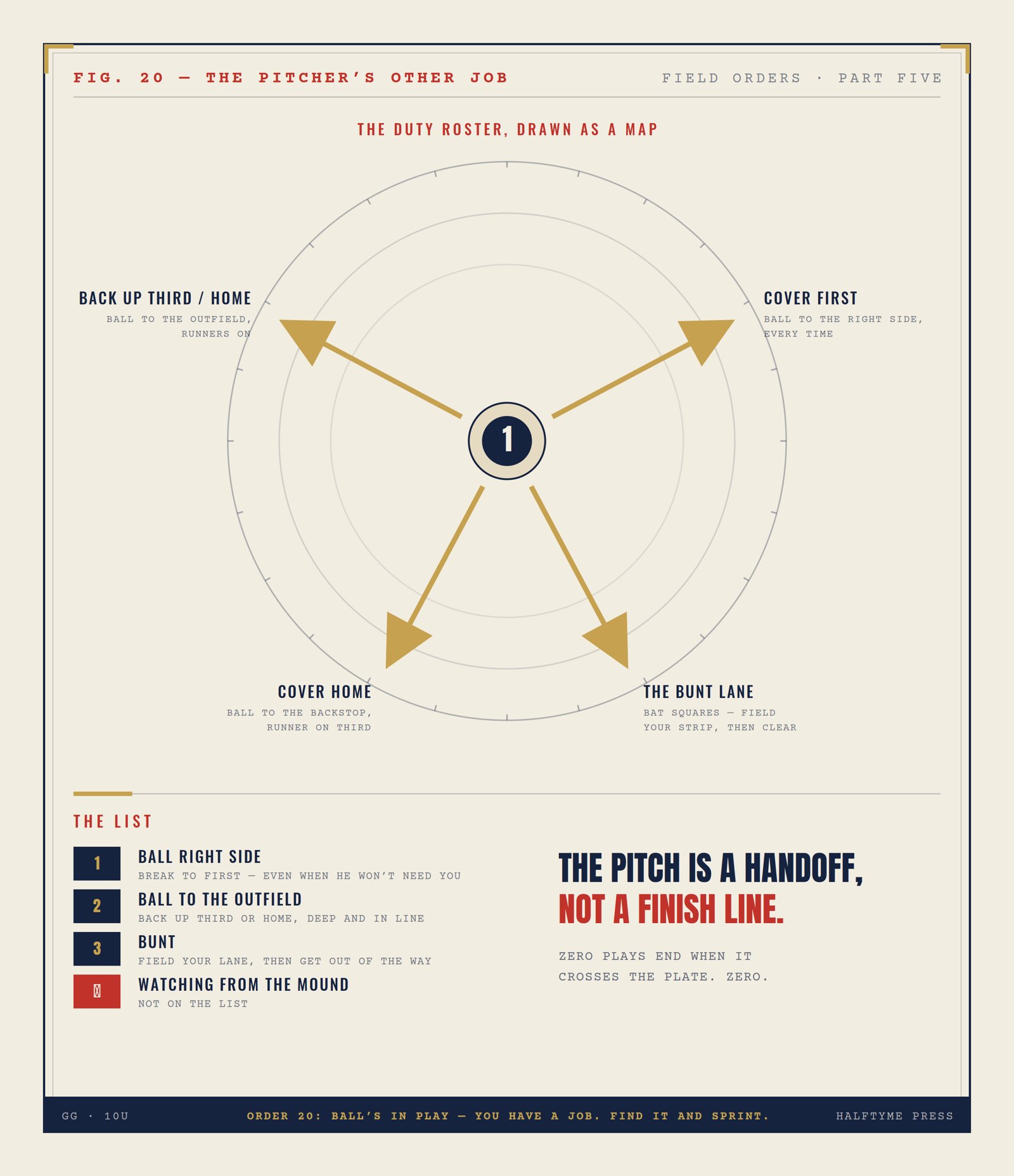
The pitch is not the pitcher's job. It's the first half of it. The moment the ball leaves his hand, he becomes the ninth fielder — and the ninth fielder has the longest to-do list on the team.
Run the list. Ball hit to the right side: sprint to cover first — every time, even when the first baseman has it easily, because Order 10 already told you why. Ball to the outfield with runners on: back up third or home, whichever base the play is coming to, deep and in line, because Order 11 owns him too. Bunt: field your lane, the strip in front of the mound, then clear out. Wild pitch or passed ball with a runner on third: sprint to cover home while the catcher chases — the plate can't stand empty with a run bearing down on it.
Notice what this list really is: it's the whole book, applied to one position. The pitcher doesn't get new rules. He gets everybody's rules, because he's the only player standing in the middle of every single play.
The List
Four Reps — Write It In
Ground ball to the second baseman, routine. You just pitched. Where are you going, and when did you leave?
Single to center, runner on second rounding third. Pick your base to back up, and describe your spot in Order 11's words.
Runner on third, your curveball skips to the backstop. Two players need to move instantly. Who, and where?
Count the plays in a full game where the pitcher's job ends when the pitch crosses the plate. Write the number.
The Trap
Pitchers watch. It's the most natural thing in the world — you threw it, so you spectate what happens to it. But the mound is the worst seat in the house, because it's the only one with a job attached. The pitch is a handoff, not a finish line. The kids who understand that are the ones coaches trust with the ball in big games.
Rep D's answer is zero, and I want you to sit with that. Zero plays. There is no pitch in any game you will ever throw where the crossing of the plate ends your responsibility. The arm gets the attention. The legs get the wins. Every Part of this book you've read so far — motion, coverage, backup, relays — the pitcher carries all of it, on every pitch. That's why the ball starts in his hand.
Ball's in play — you have a job.
Find it and sprint.